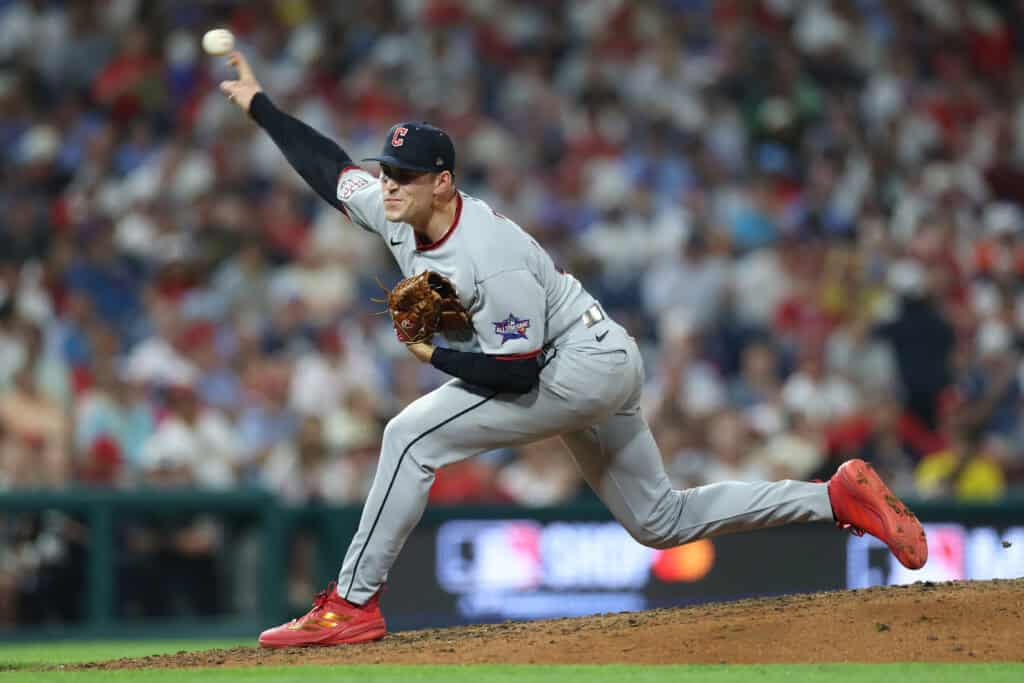
Parker Messick continued to build his case as one of the American League’s premier rookies on Tuesday, and even opposing hitters have started to acknowledge just how difficult his fastball has become to handle. Messick struck out six batters over 5 and 2 thirds innings in Cleveland’s 5-2 win over the Twins, allowing two runs, only one earned, on four hits while lowering his ERA to 2.68. The outing made him the first Cleveland left-hander to throw at least five innings in each of his first 20 starts of a season since Cliff Lee accomplished the feat in 2008, a mark that speaks to both his effectiveness and his durability as a rookie. Twins designated hitter Josh Bell offered a candid breakdown of Minnesota’s approach against Messick and where it ultimately came up short.
Bell explained that the Twins had a clear plan to attack Messick’s changeup down in the zone while sitting on his fastball up, but the results did not go the way Minnesota hoped.
“He was diving balls down, sniping pitches on the bottom of the zone,” Bell said. “For the most part, for me, I was like, ‘Yeah, I’ll give him that.’ And then, with two strikes, obviously, I have to be a little bit better. But I’ve just got to tip my cap.”
Five of Messick’s six strikeouts on the night came off his four-seam fastball, a pitch that entered Tuesday’s start carrying a plus 19 run value according to Statcast, making it the third most valuable pitch in all of baseball this season behind only Milwaukee’s Jacob Misiorowski and New York’s Nolan McLean. What makes Messick’s heater so effective is not velocity, since it averages just 93.9 miles per hour, but rather how well it disguises itself against his changeup, which looks similar out of his hand before breaking differently toward the bottom of the zone.
Messick himself explained that hitters have historically discounted a mid 90s left handed fastball, which has allowed it to sneak up on opponents, though he acknowledged that as more hitters catch on, it should open up more opportunities to succeed with the rest of his arsenal. Cleveland’s coaching staff and teammates have continued to praise the sequencing between his pitches, with catcher Austin Hedges noting how difficult it becomes for hitters to settle into a rhythm against a pitcher who mixes sinkers, changeups, and fastballs rather than simply overpowering hitters with velocity. With his ERA now sitting among the best marks in the American League, Messick remains firmly in the Rookie of the Year conversation and could even factor into Cy Young discussions if his performance continues at this level.
NEXT: Guardians Hall of Famer's Son Has Signed With The Brewers